
38. BIOMECHANICS OF THE CITY
I walked. My step — echoed like a metronome in the symphony of decay surrounding me.
Every second and a half — the strike of a sole against the surface. The snowy mush underfoot squelched, releasing bubbles of black gas. Lappeenranta, this paragon of Scandinavian order, had turned into a cesspool. December, which usually bound this region in ice, had retreated. The fog brought a greenhouse effect with it. The city was sweating. Buildings, sidewalks, the skeletons of trees — everything was covered by an oily perspiration. It dripped from the roofs. Not water — a thick slime, the product of a reaction between the roof tiles and the atmospheric reagent.
I slowly moved along Valtakatu street. The straight line of my route ignored traffic rules. I walked down the middle of the roadway, cutting through the fog with my body. Around me, in the gray murk, silhouettes emerged. The cityscape had changed. The right angles, so loved by Finnish architects, were melting. The concrete boxes of houses were drooping like candles. The corners were rounding off, losing their rigidity. Stone was becoming soft, pliable, biological. The fog didn’t just hang in the air. It devoured. It corroded the molecular bonds of inorganic matter, preparing it for further processing.
It was feeding and growing.
It was executing its correct algorithm.
I nodded in satisfaction.
To the right, out of the gray murk, the bulk of the «IsoKristiina» shopping center emerged. It used to be a temple of consumption. Glass, metal, light. Now it looked like a giant rotting sarcophagus. The glass storefronts hadn’t broken — they grew cloudy and elastic, resembling a cataract on an old man’s eye. Inside, in the dark depths of the halls, nothing moved. But I felt it: there, among the racks of clothes and electronics, biomass was slowly maturing. Thousands of people who had come shopping at the Hour of Judgment remained there forever. The signal «Dawn» caught them shopping, at the registers, in cafes, on benches, in armchairs…
Now they are a single organism, fused into plastic and tile.
A large battery for the System.
— «Resource potential of the object: High,» — the Module registered. — «Harvest of Angonium is in the active phase.»
I quickened my pace. I was not interested in the ruins of the past. Ahead, through breaks in the fog, appeared the spire of the Water Tower. It loomed over the city like a giant mushroom. The concrete stem had turned black, covered with a network of pulsating veins. The reservoir at the top seemed to breathe, expanding and contracting. It was no longer pumping water. It was releasing spores. I saw heavy, dark clouds breaking off from the top of the tower, feeding the Fog, making it thicker, more physiological.
Human infrastructure had been hijacked and subordinated to logic. The water supply, sewage, ventilation — everything now operated as a single physical law. Everything worked for the circulation of the reagent.
Something crunched under my feet. I looked down. The asphalt had ended. The roadway had buckled, torn open from the inside by roots. But these weren’t tree roots. Thick, meaty cords pushing up from under the ground seemed to be devouring, greedily absorbing the humus, tirelessly seeking organics in the soil.
The earth was changing its structure. The planet seemed to be rejecting the dead stone of cities, replacing it with living tissue.
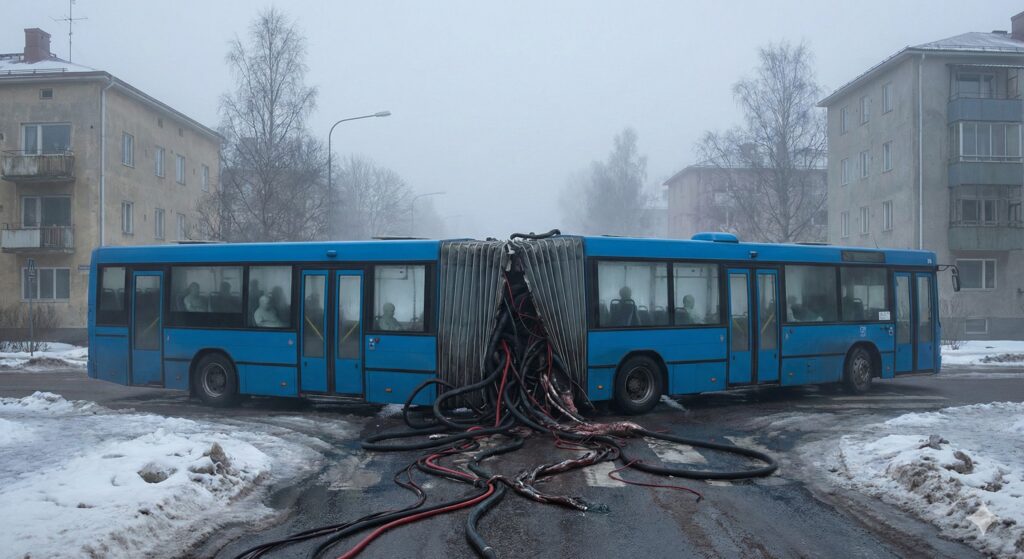
At the intersection with Kimpinen, a bus stood frozen. A blue, articulated one. It stood across the road, bent into an ‘S’ shape. The «accordion» of the articulation had burst, and out of it spilled… offal.
Wires, hoses, seat upholstery — all this had tangled into a knot resembling prolapsed, inflamed guts. In the windows of the bus, pale faces could be seen. The passengers. They sat in even rows. None of them were trying to get out. Their faces, pressed against the murky, fogged glass, were calm. Their mouths slightly open in a blissful half-smile. The skin of some had already begun to flake, disintegrating into scales soaring upwards. They weren’t going home. They were transitioning into a gaseous, formless state.
«A bus to Nowhere,» a useless, human metaphor flashed by. I swatted it away like an annoying fly. Poetry is a logical glitch. There is only the physics of the process.
Gradually, I passed the center. The buildings were thinning out. Concrete boxes gave way to private houses. Here, closer to the earth, the rotting proceeded faster. A brown mold covered the wooden walls of the cottages. It pulsated, glowing with a dim violet light in the twilight of an eternal day. Some fences had fallen over. The boundaries of private property were erased. In the front gardens, where neat flowerbeds once bloomed, bone-like growths now protruded, looking like… looking like ribs that had pierced the soil.
The Module steadily guided me precisely to the east. Toward Highway 6. Toward the forest. Where the city ended, where the Fog changed its consistency. It was becoming ragged, unstable.
The city was a zone of total control, the zone of «Dawn,» where everyone had already fallen asleep.
But the forest…
The forest had always been a territory of wild, unbridled life. And now it had turned into a territory of wild, unbridled death.
After some time, I hit the final stretch before the highway. The asphalt here had turned into a dirty-gray swamp. The snow had completely disappeared, giving way to mud mixed with fuel oil and organics. Ahead, the wall of spruce trees loomed dark. But these were no longer quite coniferous trees. The needles had fallen off. The branches, stripped of green, were crooked, resembling the jointed legs of insects. Bark hung in tatters, exposing red, moist wood.
The forest was bleeding. And it was waiting.
— «Attention,» — the Module’s tactical circuit activated. — «Entering instability zone. Bio-form mutation coefficient: Critical.»
I stopped at the border of the asphalt and the forest mud. The perfectly straight line of the road ran into the chaos of an incorrect nature. Geometry died here.
Ahead, against the backdrop of dark trunks, I made out movement.
Three blurred figures. They were clearly not part of the sleeping city. They were not dissolving in bliss. They were twitching. Apparently, the «Dawn» Signal was glitching here, on the outskirts.
Or?
Or rather…
— «Analysis,» — I commanded myself.
— «Objects rejected the ‘Submission‘ protocol,» — the Module responded. — «Reason: Excess potential of aggression in the personality’s source code. Result: Uncontrolled combat-type mutation.»
THEY are not victims. THEY are errors. And I, as the system administrator of this new world, must fix them.
I slowly clenched my fists.
Chitinous?..
In any case, looking like chitin fused with my skin, the armor on my knuckles hardened, preparing for a strike.
A step forward. Into the mud. Into the forest. Into battle.
> ⚠️ ENTITY STATUS: SECTOR PATROL. DETECTION OF DEFECTIVE FILES.
>
> 🧬 Admire the beauty of the «Dawn». The protein-based Judge in orbit gifted Earth with a sterile, painless happiness. People no longer fight, hate, or fear. They smile, melting into the plastic of bus seats, and submissively surrender their life energy to the System. A perfect, waste-free cycle.
>
> ⚙️ But in any architecture, there are errors. The forest is a blind spot where the signal struggles to penetrate. Those three waiting ahead — are not monsters. They are simply infected files whose source code turned out to be too aggressive to accept Submission.
>
> 🪓 And what does our Executioner do? He covers his fists with mutated chitin and prepares for battle. You call yourself a system administrator, piece of meat? Charming hubris. You are just a built-in antivirus. Your task is to delete the dead pixels from the perfect picture of the Underside’s world. Keep reading. Let’s see how well the new armor protects you from old, human rage.